Upcoming Events
Past events
PSI Forum 2025
Berlin, Deutschland
03. – 04. Apr 25

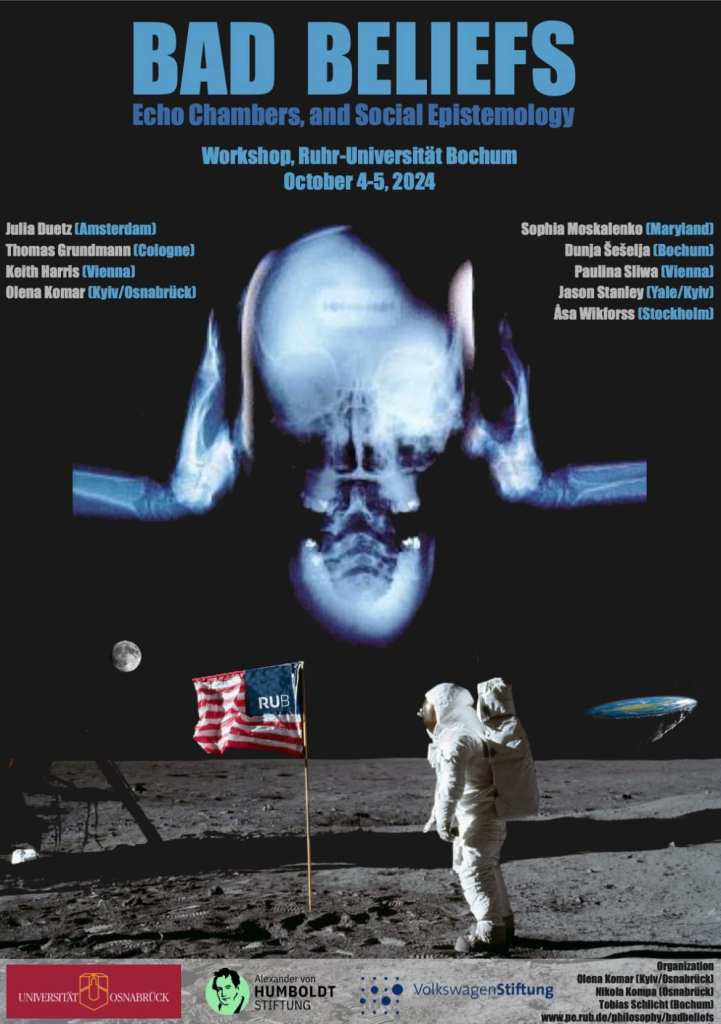
4th and 5th of October 2024: Bad Beliefs, Echo Chambers and Social Epistemology (hybrid Workshop)
Link to workshop website.
Information on registration below.
Zoom Details will follow soon.
Abstract
Some of the epistemically bad beliefs do not cause any obvious harm to others, but some, such as propaganda, are both epistemically and morally bad. Cognitive science, drawing on empirical evidence from social psychology and neuroscience, contradicts the ethics of beliefs about bad beliefs. Whereas the ethics of beliefs normatively demands responsibility for bad beliefs, as well as for preventable ignorance, cognitive science finds quite rational justifications for this. The epistemic behavior of people who hold bad beliefs, such as engaging in conspiracy theories or hateful propaganda, is not just personally motivated but is predominantly beneficial to the individual within the group. Bad beliefs become extremely persistent due to the echo chamber effect, which also contributes to further polarization of groups, and unlike epistemic bubbles, there are no obvious ways to break down echo chambers.
Can social epistemology find a balance between the strict requirements of individualistic ethics of beliefs (Clifford’s principle) and the descriptive approach of cognitive science to bad beliefs and echo chambers?
Bad beliefs are unjustified. Are they embedded in the belief system of a person or rather isolated? What is the right way to analyze immunity to evidence and its impact on a person’s belief system? Do echo chambers serve a protective function in this context? What are the epistemic, cognitive, social, and affective conditions of echo chambers? Can echo chambers be adequately described as a convenient environment for protection from moral culpability and epistemic responsibility, as well as a source of moral blindness and epistemic ignorance? Do we have a duty to pursue epistemic virtues and avoid epistemic vices? Does the responsibility for bad beliefs in a group diminish or should it be distributed evenly among its members? Are people naïve enough to believe in political propaganda, and can propaganda change beliefs en masse?
These and many other related questions arising in this context will be discussed by experts in the field.
Speakers
In this workshop, eight speakers will give a talk, providing us with insight from their perspective. The speakers are:
- Jason Stanley, Yale University
- Åsa Wickfors, Stockholm University
- Paulina Sliwa, University of Vienna
- Thomas Grundmann, University of Cologne
- Olena Komar, TSN University of Kyiv and Osnabrueck University
- Dunja Šešelja, Ruhr University Bochum
- Julia Duetz, Vrije Universiteit Amsterdam
- Keith Harris, University of Vienna
Organization
This workshop is organized by Tobias Schlicht (Professor for Philosophy of Consciousness and Cognition at the Ruhr University Bochum), Olena Komar (Associated Professor for Philosophy at the University of Kyiv) and Nikola Kompa (Professor for Philosophy at the University of Osnabrueck).
If you would like to attend the workshop, please send a brief mail to Rebecca Watzlawek (rwatzlawek [at] uni – osnabrueck DOT de) where you state your affiliation as well as which days you will be attending.
23rd and 24th of November 2023: Brain, Culture, Personality: Interdisciplinary Ukrainian Conference with international participation – intersections of neuroscience, psychology, humanities & arts
Title of Talk: Epistemic bubbles and echo chambers as mechanisms of social polarization
Link to Event
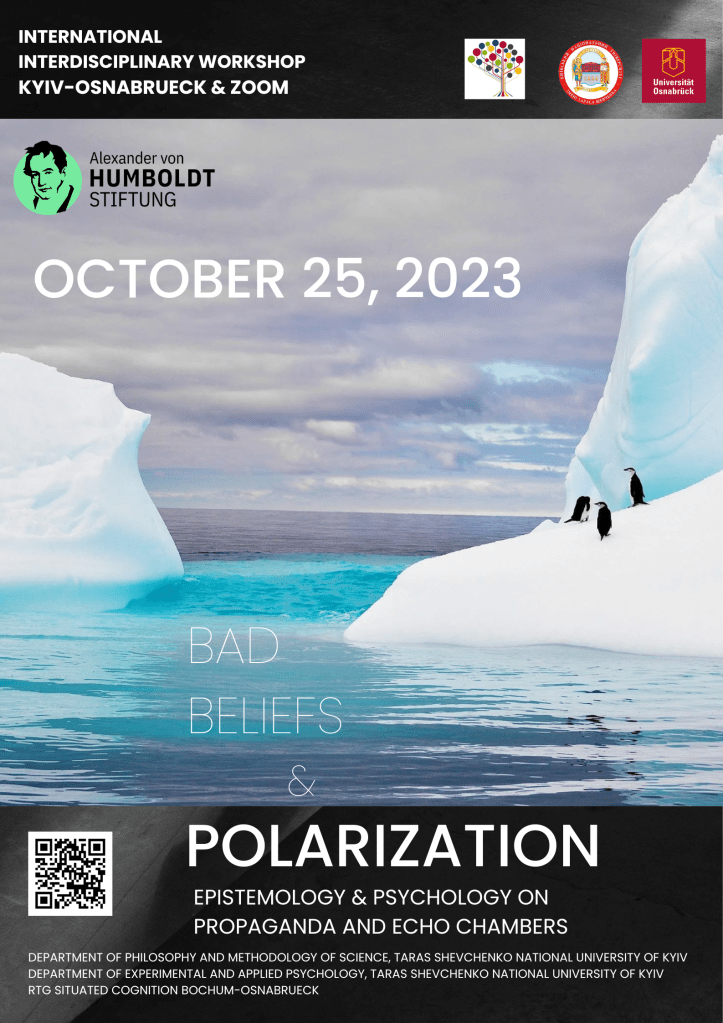
25th of October 2023: Bad Beliefs and Polarization – Epistemology and Psychology on Propaganda and Echo Chambers (Workshop)
Abstract
Climate change denial, the anti-vax movement, Pizza Gate, and political propaganda — what unites these seemingly disparate phenomena?
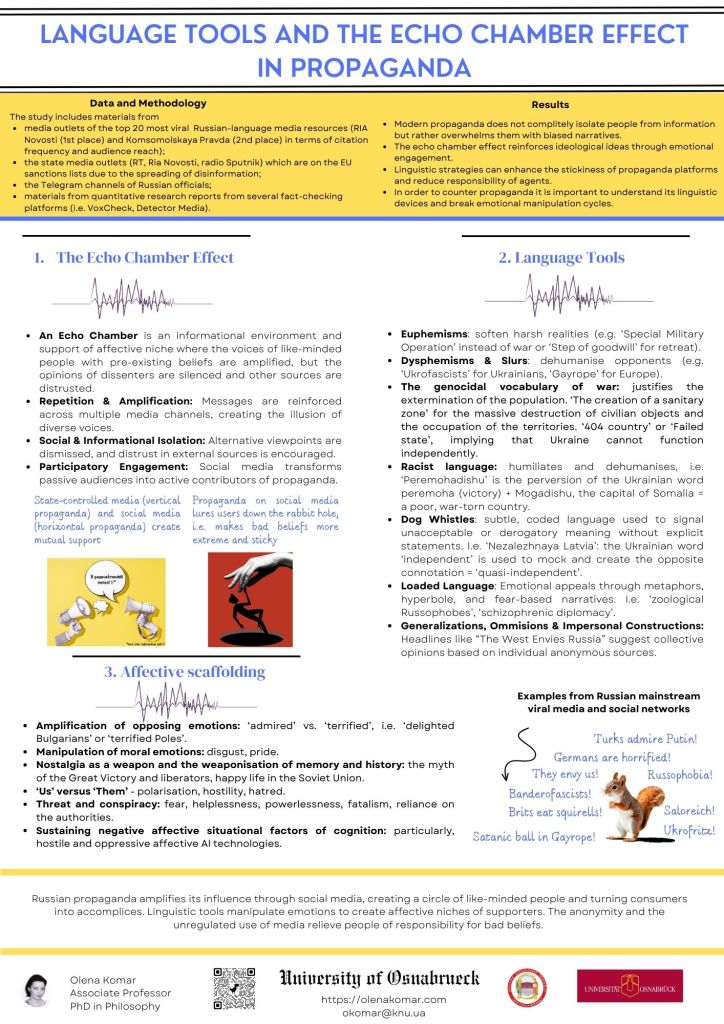
They are related to inappropriately formed, unfounded beliefs that contradict available evidence and expert consensus. In essence, they are manifestations of what we refer to as “bad beliefs.” Some of these bad beliefs are persistent, proving resistant to revision, and expressed by a group of like-minded people. Within such groups, an echo chamber effect takes hold, amplifying these beliefs and creating a resonance that binds the group together while isolating them from opposing viewpoints. Propaganda perfectly manipulates the echo chamber effect, leading to extreme social polarization.
In this workshop, we delved into the language of propaganda, and explored whether specific language is a means of polarization and a mechanism for creating an echo chamber or simply a symptom and result of polarization. We also discussed the issue of the persistence of bad beliefs and the selective effect of propaganda from both philosophical and psychological perspectives.
Link to Event: Bad Beliefs and Polarization Workshop
 Olena Komar